African intellectual property law, practice and policies. This weblog provides news, information and comment on IP law, practice and business deals right across Africa. Ce blog propose des actualités, informations, et commentaires sur la législation et la pratique en matière de propriété intellectuelle et de droit des contrats d'affaires en Afrique. For some insight into the origins of this blog click here.
Friday, 30 September 2011
Anti-Counterfeit Friday
Ghana: Hewlett Packard has announced a significant local seizure of counterfeit printing supplies destined for HP printers. The company supported Ghanaian law enforcement officials who confiscated nearly 1,100 illegal items in a highly coordinated strike. Over the last four years, HP has assisted in the seizure of nearly nine million pieces of fake printing supplies products and components in Europe, the Middle East and Africa. (GhanaWeb)
"If there is one thing that we all recognize, it is that intellectual property crime is a problem of global dimension," said U.S. Department of Justice Assistant Attorney General Lanny Breuer in late September at the 2011 International Law Enforcement Intellectual Property Crime Conference. Voanews
East Africa: The Ugandan Daily Monitor reports that the National Drug Authority warned that counterfeit antiretroviral drugs – used to manage HIV infections – could find their way into the Ugandan market. The authority's Executive Secretary warned that the World Health Organisation had already found counterfeit Zidolam-N drugs on the Kenyan market.People living with HIV/Aids who take counterfeit antiretroviral drugs could suffer diminished immunity or develop resistance to the genuine drugs.
Each year more than half a million people worldwide die while using bad drugs to treat malaria and tuberculosis alone. Now a group of start-up companies, including Sproxil, is offering consumers a more reliable way to make sure their pills are genuine. The new method relies on two technologies that are ubiquitous in the third world: text messaging and scratch-off labels. Nigeria has reported some successes using the technologies. (New York Times) “For tuberculosis and malaria alone, up to 700,000 people die every year due to fake products,’’ he said. “That’s four jumbo jets full of people dying every day.’’ (Boston Globe reporting on the same development)
Tanzania: In a bid to decrease the counterfeit imports in the country, the government will start linking local traders to Chinese supplier who produce genuine goods. According to the article traders in the country do not know when they are dealing with rogue traders and the government initiative is designed to reduce this risk. (The Citizen)
| Reactions: |
Tuesday, 27 September 2011
Update: TK Bill, Brand Africa and China
For the first time, pan-African consumers have been given an opportunity to vote for their most admired and valued brands. The continent’s most valued brands will be revealed at the inaugural Brand Africa100 Awards to be held in Johannesburg on September 29, 2011, at the Sandton Convention Centre. Brand Finance plc is responsible for the valuation work. More information here.
Meanwhile, the Chinese government recently made this statement in connection with the plight of people living in the Horn of Africa. "The international community should actively support African countries in realizing food security and development, provide greater assistance to Africa's agricultural development, and adopt more favorable policies toward African countries in terms of intellectual property, market access and technology transfer." Clarification required here please: the problem of asking for a relaxation of IP laws is that it may facilitate the spread of counterfeit goods, which mainly come from China, risking food security and general health even further.
| Reactions: |
Monday, 26 September 2011
A to Z of African official IP websites no.15: Republic of Djibouti
- The Copyright and Neighbouring Rights Office (Ministry of Communication and Culture) is the office responsible for copyright and related rights in Djibouti.
- Currently, this office has no web presence.
- The Industrial Property Unit (Ministry of Commerce, Industry and Handicrafts) is the competent office responsible for the administration of intellectual property rights in Djibouti.
- The Ministry has a website (www.mci.dj). However, the intellectual property section is still under construction, hence not currently useful.
| Reactions: |
Friday, 23 September 2011
Anti-Counterfeit Friday
![]() |
| but, are those fake? |
"Ecopark facilities in Torrevieja (Spain) last week welcomed the destruction of counterfeit items seized by police this summer from unauthorised street vendors." A vast number of vendors come from sub-saharan Africa, according to the report. Not all counterfeit dvds were destroyed though "During the past years, growers of La Mata Vines have been hanging counterfeit CD’s on poles and when the grape are ripe, so that, with the reflection of the sun, they scare away the birds from their crops" see full report here. | Reactions: |
Thursday, 22 September 2011
Accelerating IP and Innovation - Cape Town
| Reactions: |
Wednesday, 21 September 2011
Nigeria : the role of IP in nation building
"..recent global developments have made it evident that natural resources endowment is no longer the prime source of national wealth or prosperity. Science and innovation have become the key driving force for propelling national economies,”
"..have to start from the primary schools and not only at the research institutes and universities, where you get innovations,”
"The Nigerian government has, through the creation of NOTAP under the federal ministry of science and technology, demonstrated its determination to promote and acquire technology, especially encouraging the entrepreneurs, researcher and inventors to protect their intellectual property by putting a lot of structures in place, including establishing of 30 Intellectual Property and Technology Transfer Offices (IPTTOs) in research institutes and institutions of higher learning across the country."
| Reactions: |
Tuesday, 20 September 2011
TK Bill reprieve .. but don't forget to vote
| Reactions: |
Monday, 19 September 2011
TK Debate - your views needed
The debaters urgently need your views!
The Chair has provided all of the background information in a motivational post here. For further information and previous Afro-IP posts, please click here or type in "traditional knowledge" in the search function.
Could you please take a few minutes to vote on the Poll alongside or enter your comments at the bottom of this post?
- Is TK worthy of protection?
- Should RSA wait for the WIPO model?
- Does the Bill need serious re-drafting?
- The Bill is nearly ready, push on!
| Reactions: |
A to Z of African official IP websites no.13: Republic of the Congo
The Republic of the Congo, not to be confused with its neighbour the Democratic Republic of the Congo (DRC), is signatory to international agreements on intellectual property such as the Paris and Berne Convention. It also belongs to the African Intellectual Property Organization (OAPI) – a regional system based on the Bangui Agreement.
- The Congolese Copyright Office (Ministry of Culture and the Arts) is the office responsible for copyright and related rights in Congo.
- Currently, this office has no web presence.
- The National Industrial Property Unit, Directorate General of Industry (Ministry of Industrial Development and Promotion of Private Sector) is the competent office responsible for the administration of intellectual property rights in Congo.
- Currently, this office has no web presence.
Similarly to its neighbour, the DRC, recent civil wars and militia conflicts have stifled economic development in Congo. As a result, there isn’t much enthusiasm for legislative conformity and/or strong enforcement of IPRs in line with (minimum) international standards.
| Reactions: |
Stellenbosch IP Conference: Part 4
Harms started the morning session with a paper entitled “The Ossification of IP Law in South Africa”.
RSA laws are not adapting at the rate appropriate for sustainable development. This is not the first time Harms has said so and Afro Leo was able to scribble down notes of his discontent over “misfiling and lost files”, “delays in processing trade marks at CIPRO”, the “state of our legislation” eg Counterfeit Goods Act conflicts with the Customs Act. Yet we carry on regardless … “on the rims” and his view that the proposed Traditional Knowledge legislation “will kill IP as we know it”.
Harms was critical of the Government’s apathetic attitude toward IP and their perception that it is “for rich countries” citing several examples that illustrate the direct relationship between patent applications and economic growth. He felt that there is only a reaction when “parochial issues hit Government in the eye” eg the latest ant-counterfeiting Government initiative.
He also pointed out that practitioners are failing to create arguable cases on the issues. His talk was peppered with interesting personal anecdotes and examples but was not intended to be “profound”. He concluded that there is a “vital role in revitalising the subject [IP in RSA]”.
Next up was SAIIPL president, Tshepo Shabangu speaking on "Future Challenges [for SAIIPL] for Intellectual Property Law and its Practice in South Africa".
She focused on three key areas; the lack of appropriately skilled IP specialists in the judiciary [and what can be done about it, highlighting an international trend toward specialist courts, and possibilities of lawyers and advocates sitting as adjudicators]; the need for SAIIPL to train and educate [which it does] and its ability to assist draft (or have an impact on) new legislation [blunted by a lack of trust and perception that it serves only its self interest i.e. mainly law firms].
Mr P Siemsen (Danneman Siemsen) shared his thoughts on IP and its relationship with sport as an instrument that could be used for economic growth in developing economies. Essentially, “IP is a very important tool to ensure possibilities that sport can deliver to developing countries”.
Congrats to the Chair on their first effort.
| Reactions: |
Rwanda Joins ARIPO

Rwanda has finally joined ARIPO (Africa Regional Intellectual Property Organisation), having deposited its instrument of accession on the 24th June 2011. According to the ARIPO web site, "the Harare Protocol will enter into force with respect to the Republic of Rwanda on the 24th of September 2011".
This will bring the member states to 18. This is a significant step as Rwanda continues to set the pace as a the lead country in reforming its business environment, policies and legislation. Acceding to the Harare Protocol will assist Rwandan businesses to use the ARIPO system to file Patents, Trademarks and Industrial Designs within the 18 member states in an easier manner than before. More importantly, if the Rwandan Intellectual Property registry can show itself to be more efficient than other registries within the ARIPO system, it stands to reap more in terms of fees, as applicants may use it as the registry of choice.
This will continue to shed a positive light on Rwanda in the World Bank Doing Business index, as well as in the East African Community(EAC), where it continues to attract great attention as a good destination for investments in the services sector.
We welcome you Rwanda, thanks to the change makers at the Rwanda Development Board (RDB) and wish you all the best!
| Reactions: |
Wednesday, 14 September 2011
Stellenbosch IP Conference: Part 3
| Reactions: |
Tuesday, 13 September 2011
Copyright Offices in Africa: has anyone got a list?
"Is there by any chance a list of Copyright Offices in Africa, or at least the contact details of some of them? I would like to add this to my Copyright Libguide which you can find here".Come on, readers, can you help? If there isn't a list already, we should compile one, building on Kingsley Egbuonu's work on the A to Z project which this blog is pleased to host each Monday.
| Reactions: |
Monday, 12 September 2011
Stellenbosch IP Conference - Part 2
| Reactions: |
A to Z of African official IP websites: no. 12: Democratic Republic of the Congo (DRC)
The Democratic Republic of the Congo is a contracting party to most international (including regional) agreements on the protection of intellectual property rights. At national level, the main IP laws are: the Ordinance-Law No. 86-033 of 5 April 1986 on the Protection of Copyright and Neighboring Rights (1986) and the Industrial property. Law No. 82-001 of January 7, 1982.
- The Secretariat General of Culture, Directorate of Research, Planning and International Cultural Relations under the Ministry of Culture and the Arts, is the competent office responsible for copyright and related rights in DRC.
- Currently, this office has no web presence.
- The Directorate of Industrial Property, Secretariat for industry and small and medium enterprises (IPMEA) under the Ministry of Industry and SMEs is responsible for the administration of intellectual property rights in DRC.
- Currently, this office has no web presence.
Like most developing countries, DRC lacks a strong, bespoke regime for the protection and enforcement of intellectual property rights (IPRs). But, considering its recent history of armed conflict, the current state of affairs can be excused – and it is fair that reasonable time should be allowed for it to comply with requisite standards.
| Reactions: |
Thursday, 8 September 2011
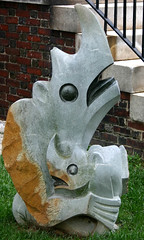
Hope for Zimbabwean Sculptors
Zimbabwe newspaper The Herald recently ran a column by Dr. Tony Monda, an expert in Art and the business side of art, entitled “Is Zimbabwean art safe on the Internet?”. Within this interesting and informative article is a highly charged plea for international protection of Zimbabwean sculpture.
Reading Dr. Monda’s post, one might think that there is no protection available for Zimbabwe artists. Indeed, it may seem that way to many of them and Dr. Monda, but it is not the case. The issue is not a lack of protection, but only a lack of enforcement. And, the really good news, enforcement is available. The problem is likely few artists know about the protections granted or how to enforce their rights under these protections.
Dr. Monda asks a number of questions:
What mechanisms do we have at our disposal for the defence and protection of our intellectual property?
Have the local legislation, patent and copyright laws been amend to include the international protection of Zimbabwean cyber-images on the Internet?
Who will monitor or marshal these international cyber felons and the colonial looters?
What punishment can be meted out to these invisible, virtual, foreign gorgons?
Mechanisms
The Zimbabwe Copyright Act protects sculpture as an artistic work. Granted the 1967 act is a bit old and could probably use some updating, but that doesn’t mean Zimbabwe artists are left out in the cold.
Zimbabwe is a member of the Berne Convention and TRIPs, which means that Zimbabwean artists’ copyright rights are protected in other Berne countries the same as they are in Zimbabwe. Dr. Monda is mostly concerned with infringements occurring in the US and Europe. The United States and the majority of European countries are also members of Berne, so Zimbabwean artists’ rights are protected there as well.
Local Legislation
Dr. Monda asks about the protection of “cyber-images on the Internet.” However, he’s really concerned about the protection of sculptures where the means through which the sculptures are being copied is pictures available on the internet. The sculptures themselves are protected by the 1967 Copyright Act (Sec. 2). Copying the sculpture by looking at the sculpture or by looking at a photo of the sculpture is still copying the sculpture and this little Leo suspects that shouldn’t be a problem in an infringement case. Photographs are also protected by the 1967 Act and whether that photo is posted online or printed on a piece of paper should not matter either.
Zimbabwean artists will also be protected by the local legislation in any Berne member-countries via national treatment.
Monitoring Cyber-felons
Ah yes, the part that seems to drive all intellectual property owners bonkers. While there have been many changes such that governments are getting involved in copyright enforcement, copyright is at heart a personal right, owned and maintained by the person or entity in possession of the copyright. It’s probably not the answer Dr. Monda would like, but it’s not a bad answer. From Dr. Monda’s article, we see that some artists do become aware of infringements of their works. “This writer has been approached by several prominent Zimbabwean artists with complaints of seeing replicas of their work on the Internet on Euro-American websites.”
Artists can police websites themselves, work together to help each other spot infringements and ask supporters of their work to keep their eyes open. There may also be other ways to look for infringing items or to work on authenticating the real artwork, thus building up its value over infringing copies.
Punishment
And now we get to the real meat. Perhaps in the country’s current state, the Zimbabwe courts may not be the best places to try to bring a copyright infringement suit. But remember, the infringements of which Dr. Monda speaks are occurring abroad, in Berne member countries. Most courts (as far as this Leo knows) grant jurisdiction in the place where the infringement occurred. Punishment would be either under the local or Zimbabwean Act as decided by the court.
The best scenario is one in which the artist knows who the infringing party is, where the infringing copies are being made and where the infringer resides. In cases where this is not known, a lawyer can help find the answers through various domestic legal tools.
Of course, the natural response to the suggestion that Zimbabwean artists bring suit in the countries where the infringement is occurring would be that the Zimbabwean artists are likely short on cash. This Little Leo suggests starting in places that allow contingency fees. (In the United States, whether an attorney can accept contingency fees for a case is governed by state law.)
So, Dr. Monda and Zimbabwean artists, don’t give up yet. You don’t have to “vow[ed] never to have an image of [my] art on the Internet.” You just need a lawyer, and there are probably many foreign lawyers who can help you enforce your rights in their jurisdictions.
Photo: 205_0597 (Sculpture on the grounds of the Embassy of Zimbabwe) cc-by dbking available at http://www.flickr.com/photos/bootbearwdc/24228763/in/photostream/
Wednesday, 7 September 2011
Insuring against disparagement? - Santam v Dial Direct
"It’s not very often that we South Africans get treated to a spat of robust comparative advertising, let alone one that ends up in court, which is why local IP practitioners will be licking their lips at the recent dispute between insurers Santam and Dial Direct.
Beginning May 2011, Santam began airing their “Real McCoy” TV ad (available here and here) featuring the Oscar winning Sir Ben Kinglsey strolling down Noordhoek beach in a grey suit, lamenting the inequities of some insurance policies (because, naturally, this is what Sir Ben Kingsley concerns himself with when strolling along the beach). The advert then ends with Santam’s “Insurance good and proper” tagline.
Dial Direct, no doubt anticipating Santam’s displeasure, rather cunningly began airing the parody over the weekend of 2 July 2011. Santam, clearly not amused, fired off the usual salvos alleging copyright infringement and unlawful competition. Dial Direct refused to relent and Santam proceeded to obtain an urgent interim interdict in the Western Cape High Court requiring Dial Direct to remove the ad from circulation pending the return date for the final hearing (the founding papers can be downloaded here).
Now what’s particularly interesting here is that there was no reproduction (whether mechanical, digital or otherwise) of the actual footage of the Santam ad – Dial Direct filmed an entirely new ad. So it seems that Santam may be claiming copyright over an idea, and not the material expression of the idea (being the footage itself). Apart from claiming that the parody ad reproduces the Santam ad, Santam also claims that it is an adaptation which, in respect of cinematographic films, is not defined in the Copyright Act.
In terms of copyright law then, this case raises all sorts of rather tricky points surrounding the idea/expression divide; the definition of “adaptation”; whether Dial Direct could squeeze its ad into one of the rather limited exceptions provided in the Copyright Act and whether the right to freedom of expression should temper copyright law in the face of parody (think Laugh It Off). I can do no better than to refer readers to Andrew Rens’s (previously of the Shuttleworth Foundation and Creative Commons, currently pursuing an SJD at Duke University) excellent blog on these issues and more, available here. For a great analysis of the applicability of the ASA code to this matter, see Delene Bertasso’s piece here .
Regarding the unlawful competition angle, Santam appears to be relying on disparagement as the cause of action. This is a recognised form of unlawful competition in South Africa (see ch 11 of Van Heerden-Neethling’s Unlawful Competition) requiring, amongst others, proof that damage in the form of lost custom is probable. What isn’t clear is the extent to which our courts will be prepared to assume that damage is probable where all that is clear from the papers is that the material in question is disparaging and that many people will be exposed to it. Our courts have been willing to assume that damage will follow in passing off cases where the two elements of reputation and deception have been proved – perhaps our courts will follow the same route in relation to disparagement?
One can’t help but get the feeling that there may have been a third way for Santam that may or may not have yielded more productive results. Perhaps, with all the creative talent we have in this country, all those billable hours could have been spent on devising a tasteful retort? The South African public tends to respond well to that sort of thing – remember BMW’s brilliant “Beat the Bends” come back? (see here). No doubt the Streisand effect is about to kick in, hopefully thanks (or not) to this post!"
![]() |
“You also have to keep in mind that these people are brands in their own right and won’t do anything they don’t like or that’s puts them in bad light. We were very lucky with Sir Ben...".
This may explain the action taken by Santam but one cannot help feel too, that Jeremy has a point: what would you do if you were Santam or Ben for that matter?
| Reactions: |
Monday, 5 September 2011
Nigeria, UK to cooperate -- but exactly how?
"A landmark copyright agreement has been signed between the Intellectual Property Office (IPO) and counterparts from Nigeria. The agreement is the first of its kind between the IPO and an African country, and will improve international cooperation on copyright issues between the two nations.Afro Leo wonders (i) what is the international cooperation that will be improved by this agreement, (ii) what sort of information is going to be shared and (iii) what sort of opportunities for training and development the two countries have in mind. Do any readers know?
The move follows the UK Government’s acceptance of the recommendations made in the Hargreaves Review of intellectual property and growth. The review highlighted that the UK should continue to pursue international interests in intellectual property.
Minister for Intellectual Property Baroness Wilcox said:
The agreement was signed today (5 September) in London by the IPO’s Chief Executive John Alty and Chief Executive of the Nigerian Copyright Commission, Afam Ezekude".“Effective copyright law in the UK and Nigeria is essential for the future growth of both nations’ creative industries. Businesses need to have confidence in the intellectual property systems of other countries if they are to prosper in international markets.“This agreement will create opportunities for information sharing as well as opportunities for training and development in the UK and Nigeria.”
| Reactions: |
A to Z of African official IP websites: no. 14: Côte d'Ivoire
- Ivorian Copyright Office, Ministry of French Language and Culture, is the competent office responsible for copyright and related rights in Côte d'Ivoire.
- Currently, this office has no web presence.
- Ivorian Office of Intellectual Property (OIPI), Ministry for Industry and the Promotion of the Private Sector (OIPI) is responsible for the administration of intellectual property rights in Côte d'Ivoire.
- Currently, this office has no web presence.
| Reactions: |
Friday, 2 September 2011
University of Stellenbosch: Intellectual Property Law Conference
The Chair (see more information here) represents a “new horizon” for the University, namely a dedicated focus on IP and in particular IP in the digital environment and also its conflict with human rights. The goals for his position as Chair were to help create:
· a centre of excellence for IP,
· an IP diploma for lay people,
· an international role for the University as a recognised IP centre,
· a centre that could assist in drafting legislation, provide government assistance and "champion" IP in RSA
Dean’s talk (which included mention of his big bugbear – the Traditional Knowledge legislation) was followed by opening speeches by Prof Lubbe (who gave us more information on the reasons why it is called the Anton Mostert Chair in honour of the late Judge and jurist, and that its existence was because of Dr Johann Rupert) and Prof Van Zyl (who explained the University’s need to “add value” to the community, have a "balanced engagement with the knowledge network" and the considerable benefit of the University’s IP to date eg in satellites, drug discovery and wine biotechnology).
Interestingly Van Zyl described the role of the University as important in ensuring the recent legislation on IP created by public funds does “not push potential partners away”.
Afro Leo will post more information on the conference content and speakers when he has an opportunity. Right now he is combing his mane in anticipation of Judge Harms’ address entitled “The Ossification of IP Law in South Africa" followed by SAIIPL President's (Ms Tshepo Shabangu) view on "Future Challenges for Intellectual Property Law and its Practice in South Africa".
| Reactions: |
Thursday, 1 September 2011
South Sudan: a little news on copyright and trade marks
"Proprietors and practitioners alike are expressing concern about the protection of Intellectual Property rights in the recently constituted territory of the Republic of South Sudan (“South Sudan”)....
Article 198 of The Transitional Constitution of the Republic of South Sudan, 2011, which came into force on 9 July 2011, states that
“[a]ll current Laws of Southern Sudan shall remain in force and all current institutions shall continue to perform their functions and duties, unless new actions are taken in accordance with the provisions of this Constitution”.
The “new actions” referred to in Article 198 probably envisage the promulgation of domestic Intellectual Property laws by the South Sudanese Legislature, which consists of the National Legislative Assembly and the Council of States. The “current laws” in South Sudan probably refers to the laws which were in force in the territory when the Transitional Constitution came into force, which would include the Sudanese Copyright and Neighbouring Rights Protection Act, 1996 and the Trade Marks Act 1969 and regulations.
Therefore, if our analysis is correct, it would appear that Intellectual Property rights in South Sudan are currently regulated and protected in terms of the Copyright and Neighbouring Rights Protection Act, 1996 and the Trade Marks Act, 1969 and its regulations.
It would appear that a Registry, which falls under the Ministry of Legal Affairs and Constitutional Development, is indeed allowing the filing of trade mark applications, but merely follows a deposit system whereby a certificate is issued on settlement of official fees. It is not clear whether this is being done under the auspices of the Trade Marks Act and its regulations or other legislation, because the process appears to be contrary to the requirements of this Act.
What is becoming increasingly clear is that registrations secured with the Registry in Khartoum, Sudan are only now valid in North Sudan and it is unlikely that there will be any priority given when filing fresh applications in South Sudan.
It is difficult to be certain regarding the regulatory framework to obtain trade mark protection until associated rules, processes and systems have been formalised ...".The prospect of further information in due course is held out.
| Reactions: |