Showing posts with label software. Show all posts

Friday, 24 October 2014

Afro Leo

India investigates Mr Cricket software over IP misuse

As Hashim Amla completed his 16th ODI ton within the last few hours in what looks to be an easy victory for the South Africans over New Zealand (currently 90/5 chasing an imposing 289), Hashim's picture appears in The Indian Express under the heading Bangalore Cops Probe South African Cricket Team's Analyst. 

Hashim is pictured alongside software analyst Prasanna Agoram, the performance analyst of the South African cricket team to whom he dedicates a triple ton in England. According to the article, Mr Prasanna who recently licensed his software tool Mr Cricket to Cricket South Africa, is being investigated for breaching copyright and know how laws in India:

Prasanna
"In the first of its kind case in India since the emergence of computer analysis of cricketers as a key coaching tool, cyber crime police in Bangalore are investigating a top performance analyst with the South African national cricket team for alleged theft of proprietary coaching software belonging to a company run by a former India and Karnataka cricketer."

We are seeing more and more of these types of cases (see here and here, for example) and it has been apparent from the audience attending these Breakfast Seminars that the protection of know how and software is increasingly of interest. 

Software, is of course, largely protected by copyright and contractual relationships regulating confidential information and termination of employment (eg restraints of trade), and occasionally a smart patent lawyer can obtain patent protection. However, because of:
  • the difficulties in determining who owns copyright in software (eg establishing who did exercise control under South African law, for example), 
  • showing proof of copying (re-engineering is generally acceptable and it can be difficult to obtain evidence of copying) 
  • NDAs and employment contracts are often badly drafted or not entered into at all; and
  • courts can be expensive and understood to be risky
the perception (at least in South Africa) is that very little protection exists for software. The reality though is that proper agreement work regulating ownership and proper advice on IP structuring within ventures can save a tremendous amount of time, cost and effort when things go wrong (which they often do as is illustrated by The Indian Express). 

There is also strong protection under the Counterfeit Goods Act for software piracy that is often overlooked as a means of obtaining evidence of copying and quick relief against copying. In other parts of Africa, eg Kenya and Nigeria specific copyright enforcement structures have been set up and have been very effective in protecting software.

It will be interesting to see what happens in India, reporting on the first ever case of its kind. If anyone has any more information, please share it. This is not the first time this blog has covered cricket related technology. For long time readers they may remember this post and the series of posts that followed. Have a good Friday. New Zealand now almost all out. Damn good software that is.
Read More

Thursday, 3 October 2013

AfroTwiga

Approaching a software patent cliff?

“Is software patentable in Kenya?” This was a question posed at a conference held in Nairobi last year. In this Leo’s opinion, the answer is “yes”, primarily because of a change in the Kenyan patent law in 2001. The old law explicitely excluded software from patentable subject matter, but the revised law conspicuously omitted the exclusion (conspicuous because other exclusions were maintained). If it was once prohibited, but is no longer, then it must be allowed, right?

driving buffalo over the cliff

charles marion russell 


“Should software be patentable in Kenya?” The same conference also posed this question, which is decidedly more difficult to answer. This post focuses on one aspect of the question, namely, whether the current system is likely to replicate the mess that patents have made in the software industry in the United States.

Software patents in the US are hard to define, are numerous in number, and are the subject of endless debates about patentable subject matter. The US courts have completely changed their treatment of such patents at least three times, making it difficult to know at any given time whether a patent is valid or invalid. More problematic is the contention that, during the ‘90s and 2000s the USPTO issued a large number of broad patents that cover many of the most basic online or mobile operations. Furthermore, such patents are frequently categorized as “weak” patents – i.e., patents that barely pass (or probably do not pass) a requirement for patentability such as non-obviousness. Nevertheless, or as a result, such patents are often used by Non-Practicing Entities (i.e., “patent trolls”) to sue large numbers of defendants, confident in the belief that most defendants will prefer to settle out of court for just less than it will cost to litigate.

Is Kenya heading in this direct? The potential is serious for two reasons. The first reason is the importance of the software industry to Kenya. The phenomenal growth of the industry in the last 5 years is unmatched in any other sector, and ICT offers substantial opportunities for high-paying jobs and entrepreneurship.

The second reason is the existence in Kenyan IP law of Utility Model Certificates. “Normal” patents are granted for inventions that are novel, useful, and, critically, non-obvious (or, if you are in Europe, involve an inventive step). Thus any patent system can theoretically weed out “weak” patents before they even become patents simply by rigorously enforcing the rules for granting patents. Weak patents tend to be for obvious inventions, so enforcing the non-obviousness criteria should limit their number.

Utility Model Certificates, on the other hand, are granted for inventions that are merely novel (and useful) – there is no requirement for non-obviousness. Almost by default, then, they are granted for obvious inventions; if the invention is non-obvious the applicant is more likely to file for a regular patent. A Utility Model certificate provides exclusionary rights for “only” 10 years. In the software industry, 10 years is still much longer than the useful lifespan of most inventions.

So, by design of the law, Kenya is destined to have a collection of intellectual property rights granted to novel but obvious inventions, including inventions in software. These are key elements in building a system ripe for exploitation by Non-Practicing Entities.

To date, the number of software-based utility model (or patent) applications filed in Kenya is very low. Nevertheless it took decades for the US to reach its current position, so a bit of crystal ball gazing may be valuable.

Incidentally, the IPKat recently posted on whether Patent Trolls are universal, and observed that they seem to be largely a US phenomenon. This Leo has a similar experience – virtually every time I ask a Kenyan audience whether they have heard of Trolls or NPEs, not more than one or two hands are raised. Let us hope it stays that way!


Read More

Monday, 9 September 2013

Darren Olivier

South Africa's Draft National IP policy - copyright notes

South Africa's draft IP Policy was published last week for comment within 30 days. 

What is the IP Policy?

It seeks to provide a national approach to all issues around intellectual property. In other words it would be the policy that guides future changes to, for example, legislation. It is important because it records the relative priorities of the country with respect to IP matters, and makes recommendations. 

Copyright and Software

Today, this Afro Leo considers the draft policy as it affects copyright and, in particular, the software industry. This is useful against the other big news last week - Microsoft's (MS) purchase of Nokia - a deal which is all about the perceived benefits of a jointly controlled IP portfolio (see IP Finance synopsis here). Put differently, the deal is an example of IP at work in the developed world by developed companies that create jobs, educate, innovate and whose technologies provide solutions. 

In a RSA context, solutions created by the software and device industry include facilitating access to information eg online University courses as well as services that assist in providing access and education around genuine life saving drugs eg mapping technology. These “access” examples are stated problem areas for RSA (ie restricted access to information and drugs, often blamed on IP).

In addition, both companies (Nokia and MS) have offices in RSA too - see here and here). In other words, if Nokia and MS are examples of what IP can do, then embracing an IP policy that facilitates their investment in a country like RSA or creating an environment for a similar home grown company, is not a bad aspirational benchmark for an IP policy, one would think. If so, how does the draft policy document fare?

The following sections are particularly relevant:

·         Objectives (page 4)
·         Types of IP (Copyright, US Digital Millenium Copyright Act and Fair Dealing/Fair  Use) (pages 14, 16)
·         Chapter 6: Copyright, Software and Internet (page 29)
·         Chapter 15: Enforcement of IP (page 42)

Notes

·         The objectives do not appear to be controversial. It seeks to bring RSA in line with the rest of the world but emphasises that we need to be aware of RSA’s own developing needs which include “access to knowledge” and “local empowerment, especially black empowerment”. The very fact that RSA is considering a co-ordinated IP Policy is, of course, very positive.

·         In general the document appears to promote "development", sometimes at the expense of "enforcement"; the relationship between strong enforcement as an innovation and investment incentive does not seem to be fully recognised (albeit that there is a stated intention to “foster the enforcement of IP” – page 42). How does a country attract investment from the likes of Microsoft, Nokia and others, if there are not laws that protect them? The policy is not altogether clear on how it will achieve this balance.

·         There is no specific mention of innovation, job or wealth creation through the software industry. This does not mean, of course, that it is not recognised. However, there appears to be view that enforcement and stronger protection for copyright would, inherently, be damaging because it reduces access to knowledge.

·         There is a recognition that, digitally, South Africa's Copyright Act is outdated and that there is no inspectorate to deal with “cyber counterfeiters” and so, there should be ratification of “digital treaties”. It is not entirely clear what this means but the sentiment seems correct.

·         There is a view that fair use/fair dealing exceptions do not cover RSA needs. These are likely then to expand, possibly to the detriment of copyright holders. For specific cases this might be required but it is difficult to tell what those will be from the draft.

·         There is a strong emphasis by the government, on using open source software (as opposed to proprietary software) for projects. It is recommended that “copyright legislation be amended in relation to the procurement of computer programs, with a view to ensuring that options for using low-cost and or open source software products are considered...”. This seems rather simplistic - if it is a case that software owners are charging too much then it can be addressed in other ways - see here, for example.

·         There is the possibility of a legislative change to allow “reverse engineering of computer software programs” consistent with its international treaty obligations. The meaning of this is unclear and ought to be considered carefully, especially if the policy appears to seek to exclude protection for software per se (see page 30) which would likely be a disincentive to the software creators. 

·         There is a recommendation to extend the fair use provisions to include “making and distributing copies from electronic sources (which presumably could include source code)” for education and research, commentary and review. Afro Leo notes that this is already an exception in the Act (see Section 19(b)).

·         There is a hesitancy to accede to the WIPO Copyright Treaty, DMCA and EU Database Directive. “The DCMA and EU Directive restrict the number of [free] downloads, whether for commercial or personal/research use.” Again, the Policy is not clear but will no doubt create concern from proponents of strong IP policies.

·         Common strategies are suggested at regional level (SADC and AU) for enforcement. This hints toward a regional customs authority which seems positive.

Conclusion

      In general, the draft IP Policy is noble in its objectives and its form, but contains some vague and worrying statements and recommendations for the software industry.  
      
      Readers (even co-bloggers) may well have strong divergent views and are encouraged to express them. 

      *Many thanks to Marius Haman for alerting this Afro Leo to the deal with Nokia and providing published deal information, and to Susan Olivier (Adams & Adams) for providing Afro Leo with the draft Policy.
Read More

Thursday, 17 February 2011

Afro Ng'ombe

Nigeria Develops Own IP for Voter Registration

File:Election in Nigeria 1999.jpgAfro Leo usually discusses changes in IP laws or interesting cases dealing with a suspected infringement of someone’s IP, but today Afro Lea has an opportunity to highlight a different kind of IP development from Nigeria: the creation of new intellectual property for Nigeria’s voting registration system.

Nigeria’s voting system has come a long way in the last decade. Photo: Election in Nigeria 1999

Nigeria’s next big election is coming up in two months and the country is getting ready by registering its eligible voters.  A new voter registration system was recently put into place; a new system where both the software and hardware have been developed in Nigeria.

Nyimbi Odero built the registration software using a Linux operating system.  Since Linux OS’s are released under open source licenses, Nyimbi was able to develop the software without the huge expense of licensing fees for every computer running the software.  Al Jazeera estimates that this move saved Nigeria hundereds of millions of Naira.  Overall, the combined savings from developing the software in country and having it run on Linux is estimated at more than USD$100 million.

Hardware for the registration process is also being built in country. Lagos-based company Zinox has put together over 80,000 computers for collecting the registration data. 

Afro Leo is always excited to see African intellectual property for  African intellectual property laws to protect.  In the words of Zinox CEO Leo-Stan Ekeh, “Africans are taking control and this is what civilization is all about.”

Full Al-Jazeera report (video).

Read More

Wednesday, 18 August 2010

Afro Ng'ombe

Developed for Africa, by Africa

Coded in Country.  It’s a pretty catchy title and very interesting initiative starting to pick up steam across the continent.  Started by private software consultancy Dimagi, Coded in Country aims to help increase the amount of high-quality software developed in Africa by Africans.

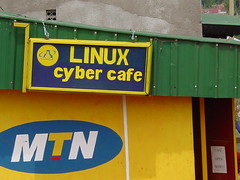
There are many talented coders in probably every country in Africa.  (For two small examples, see Linux Uganda Group and Open Source Zambia.)  Yet, as Neal Lash explains in “Beware the Foreign Expert”, a great deal of software designed for use by specific African communities is developed by coders from wealthy countries.  Lash goes on to explain why this is a problem and how initiatives like Coded in Country can help.

Coding may seem a little removed from Afro-Leos normal roaring ground, but as IP attorneys and people involved with Intellectual Property around the continent, we probably all know a few young coders and software engineers who could use a little encouragement.  These people will be a huge part of the future of their countries, and they will need legal help and guidance.  Whether determining if they have complied with the requirements of the open source license on the software they just modified, or deciding if they can patent their new program, they will turn to us for guidance.  It is worth looking into programs like Coded in Country, even if just to pass the information along.

Image credit: “Linux” CC-BY-NC-SA by amalthya available at Flickr: http://www.flickr.com/photos/amalthya/31684776/.  Warning, some might find the photographer’s caption below the picture a bit offensive.  Please be patient with the Muzungu and leave polite comments to correct her mis-assumptions rather than getting upset.

Read More

Tuesday, 10 November 2009

Afro Ng'ombe

Software Raid in Lagos Confiscates High Quality Copies

Nigeria’s Vanguard reports on a recent counterfeit software raid in Lagos.  The Nigerian Copyright Commission (NCC) confiscated a number of copies of various Microsoft products.  Unlike the usual pieces of counterfeit software collected in raids conducted by the Commission, these items were of high quality.  The NCC stated that the seller of the counterfeit goods deliberately purchased high quality counterfeit goods in order to trick even those customers who look out for counterfeit products.  The article did not say how the NCC knew that the seller himself was not tricked into thinking these were genuine Microsoft products.

Usually, the discussion about counterfeit software in Africa takes note of the harm caused by poor quality products, viruses and malware that harm the unsuspecting users computer. Since these products were of high quality, those kinds of ill effects presumably were not an issue.  However, it is important to note that the sale of high quality counterfeit goods also has harmful effects:

“Piracy is not a victimless crime. The activities of Plum Telecom put the businesses of legitimate resellers in jeopardy and impact the credibility of the Nigerian IT reselling community as a whole.” – Mr. John Ogboru of the Computer and Allied Products Dealers Association of Nigeria

Read More

Wednesday, 18 June 2008

Jeremy

Road safety organisation accuses Lagos of criminal software infringement


The Nigerian Federal Road Safety Commission (FRSC) has accused the Lagos State government of infringing its copyright when producing motor vehicle plate numbers and drivers' licences. This course of action is criminal and undermines the National Uniform Licencing Scheme, according to the FRSC's Chief Executive. It has also led to the duplication of issued plate numbers. The copyright work in question is not the number plates and licences themselves, so much as the software which enables the vehicle licensing to be effected. Source: Damilola Oyedele (AllAfrica).
Read More